
Every square metre has a job to do
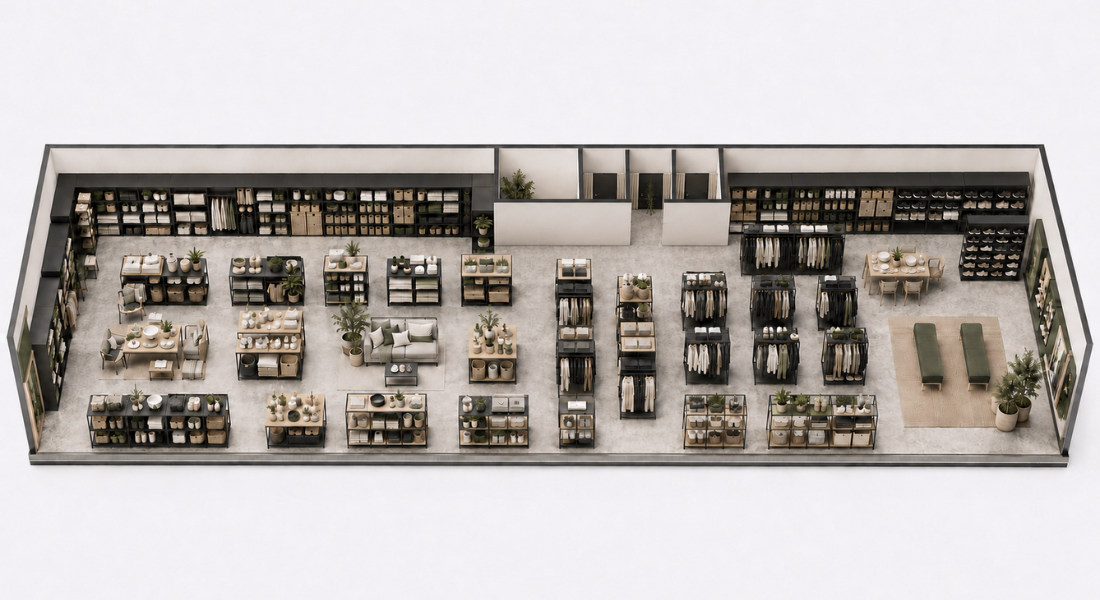
Large footprints have long been a competitive advantage for Large Format Retailers, supporting broader ranges, deeper stockholding and more immersive customer experiences. But as occupancy, construction, labour and operating costs rise, the way retail leaders assess that space is changing.
Mark Gale, CEO of Associated projects says Large Format Retailers should assess space as a commercial and operational asset – not simply a cost or through the lens of sales alone.
“The question is no longer simply, how much space do we need?” Mr Gale says. “Instead it is, what return are we getting from the space we already have?”
For retailers operating substantial footprints across multiple locations, modest improvements can become significant when repeated across an entire network. Mr Gale argues that this makes space productivity more than a property or design issue: it is a capital productivity issue.
Sales per square metre remains a useful benchmark, but it does not tell the whole story. Similar areas can generate comparable revenue while delivering very different margins, labour demands or impacts on conversion. Some spaces also support navigation, service, stock availability or the broader customer experience rather than a direct transaction.
“The better question is: what job is this space doing for the business?” Mr Gale says. “Retailers should look at sales alongside gross profit, conversion, average transaction value, stock productivity and labour efficiency.”
This broader view is especially important at scale. An awkwardly positioned fixture, poor stock location or unnecessary process may add only a few minutes of labour in one store. Across 100 stores, every trading day, that cost quickly compounds. The reverse is also true: faster replenishment, greater stock capacity, simpler merchandising changes and small conversion gains can create substantial cumulative value.
“We think about store formats as repeatable systems, not isolated projects,” Mr Gale says. “A solution needs to work in one store, but it should also be efficient to manufacture, consistent to roll out, practical for store teams and adaptable as the business changes.”
Adaptability is also part of the return equation. Retail environments rarely remain unchanged for the life of a lease. Ranges shift, category priorities change, new services and technologies emerge, and brand standards evolve. Fixtures that can be reconfigured rather than replaced, branding that can be updated independently and infrastructure that can accommodate future technology may reduce later disruption and capital expenditure.
“Sometimes the cheapest solution to build is not the cheapest solution to own,” Mr Gale says. “The value of flexibility may not be obvious in the initial construction budget, but it becomes very clear over the life of the asset.”
Measurement should begin before capital is committed. Retailers need a baseline for store performance, customer friction, category allocation, stock capacity and the labour consumed by replenishment and merchandising. Following a refurbishment or format change, the same measures can be reviewed again and, where possible, compared with similar unchanged stores.
“Without a baseline, it is easy to see that a store looks better,” Mr Gale says. “It is much harder to know whether the investment made it perform better – and that distinction matters before extending the solution to another 50 or 100 locations.”
Retail space must also be considered as an interconnected system. Increasing merchandise density may improve stock capacity but hinder navigation. Expanding a service area can reduce display space while lifting conversion. Moving stock closer to the selling floor may consume valuable area but reduce labour.
Mr Gale believes the highest-value decisions often happen before construction begins, when property, operations, merchandising, design, procurement and delivery teams assess the environment together.
“The objective is not to squeeze revenue from every available square metre,” he says. “It is to give every square metre a clear commercial or operational purpose, understand the value of that purpose and design improvements that can be repeated across the network.”