
Good site, wrong decision
Ask a Large Format Retailer why they chose a particular site and the answer is often a mix of gut feel, a landlord relationship and a deal that came up at the right moment.
All three matter. None should replace analysis.
Joseph Kalk, Director of Business Development at FLNT, and Kyle Swain, Head of Property at Fitness Cartel, weigh in on what is worth asking before anyone signs.
“Most retailers know their own network well,” says Mr Kalk. “Where it comes unstuck is when you dig deeper: who else is trading nearby, what matters in your catchment, and what the centre itself is going to look like in three years.”
Who is already trading there?
The standard advice is to map your network against your competitors before looking at any specific site. Mr Swain works the other way around.
“We tend to look at the location, site and tenancy first, and if it meets our criteria, then we would look at the competition to ensure we design the club to be the dominant offer in terms of our member offer,” Mr Swain says.
“We have such confidence in our brand proposition that we would open next door to any competitor if we felt the location was exceptional.”
Mr Kalk says the distinction matters: one retailer may use competition to decide whether to enter a market, while another uses it to determine what it must build to succeed.
Which catchment measures matter?
For Fitness Cartel, total population is the first priority before detailed demographics.
“We look at population density first,” Mr Swain says. “We know the percentage of the population that are members of a gym at any point in time and we have confidence in our ability to capture a good share of that market in any location we go to. Once we know the population is there, then we look at the demographics and can benchmark those against our member base to inform decisions around prioritising one site over another.”
Mr Kalk says that approach works because fitness appeals to a broad cross-section of the population. Retailers targeting a particular life stage or demographic, however, require a more detailed customer profile. The narrower your target customer, the harder the data has to work.
Mr Swain says each retailer’s existing network should provide the reference point. “Every tenant should be very aware of the demographics of the customer base at their best performing sites, as well as other location and economic factors related to that site, then prioritise finding sites where those success factors are replicated.”
What will the centre look like in three years?
The third question is what is happening within the centre itself: where rents sit, who else is in the tenancy mix, and when surrounding leases expire.
Market rents become more relevant for market rent reviews and other critical lease events, where you need to understand the lease data before legally committing yourself to a further term.
Mr Kalk sees that as the moment handled worst. “Everyone concentrates on the new deal, but the exposed moment is a market review or an option exercise,” he says.
“That is a decision to commit for another five or ten years and it runs to a deadline. Most tenants get there without an independent reference point, which means the only numbers in the room are those on the table and someone’s memory of the last deal. That is not a good position for either side to negotiate from.”
Expiry profile also matters for a related reason.
“Expiry is a concern because tenants that may have been complementary to your business for the initial term, could be replaced with tenants less complementary to your brand for the next lease cycle,” Mr Swain says.
Both sides of the table
None of these questions belong only to tenants. A landlord assessing a vacancy has many of the same questions from the other side of the table: which categories the catchment will support, which brands have the customer base to trade there, and what the centre’s own expiry profile means for the covenant being signed.
Understanding whether a category is already well represented in a trade area can also help an owner protect the long-term performance and balance of the asset.
Mr Swain argues the relationship should reflect how much each side is committing.
“We want landlords to have skin in the game and partner with us rather than just lease us a tenancy,” he says. “Our lease terms are 20 plus years with the option terms included, and we can significantly improve their asset and increase the valuation on that asset. We want our landlords to invest in that uplift with fair commercial terms including incentives, and maintain a positive relationship once operational.”
None of this removes judgement. Experienced property teams read a location in ways no dataset captures. What the three questions do is narrow the field before that judgement is applied, and make sure both parties are working from the same facts rather than the same assumptions.
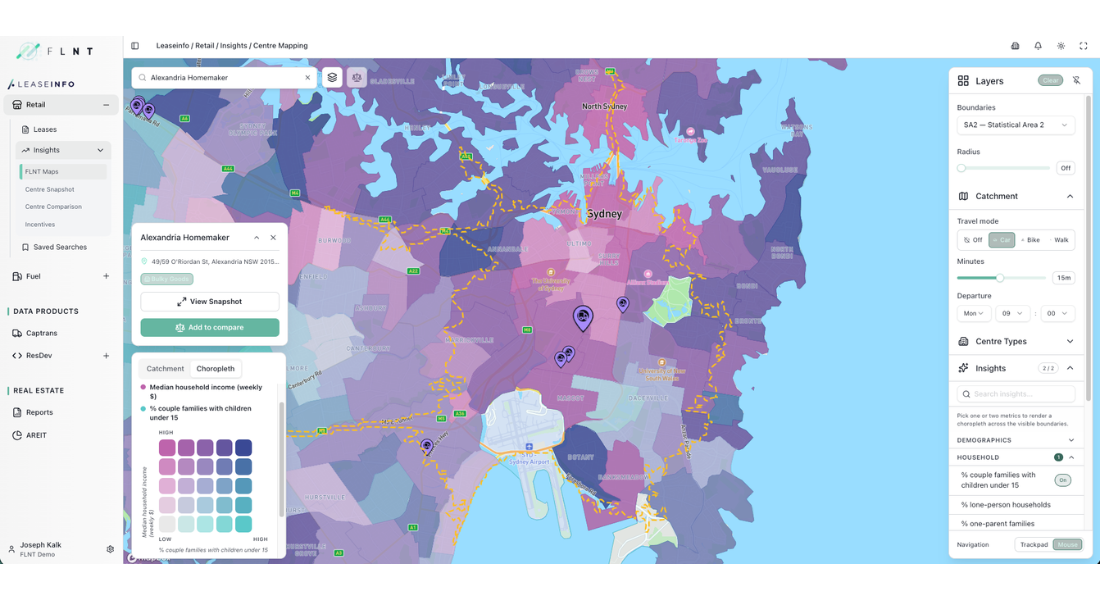
According to Mr Kalk, mapping tools such as FLNT Maps and benchmarking platforms such as LeaseInfo make that groundwork faster, but the discipline behind it matters more than the tool itself.
Mr Swain puts the test simply. It is, he says, the core of his negotiating philosophy.
“If both Fitness Cartel and the landlord are excited about signing the lease, then I’ve done my job well.”
FLNT works with Large Format Retailers, landlords and advisers across Australia. FLNT Maps covers drive time catchments, demographic profiling and competitor mapping. LeaseInfo provides retail lease benchmarking across shopping centre, Large Format and fuel assets. To discuss site selection or data access, contact Joseph Kalk at jkalk@flnt.io.