
From Dallas to Miami: COVA’s Julian Cook reflects on the LFRA Overseas Study Tour

As the 2025 recipient of the LFRA Study Tour Scholarship, I had the privilege of joining the 2025 Large Format Retail Association (LFRA) Overseas Study Tour to Dallas and Miami in May this year.
Having not been to the USA before, the experience was eye-opening. We saw many great (and a few not-so-great) examples of Large Format Retail across a huge variety of sectors. These are just a few of my notes and observations.
TEXAS
Landing in Dallas, the first thing that struck me was the separation between buildings. Each stood proudly on its own, angled to face the highway, surrounded by manicured lawns and generous carparks. It’s very much a ‘drive-between’ lifestyle, and you see that through everything.
Exploring Downtown, the atmosphere was generally calm and ordered. Even the older buildings were clean and well-maintained. The most unusual thing was the placement of pedestrian crossing buttons – hiding set back several meters from where they ought to be.
Huge thanks to CBRE’s Daniel Diebel, Economist, Henry Chin, Global Head of Research, and Ryan Arrowsmith, First Vice President- Retail Corporate Services, for giving us some insights on Texas’ retail sector, particularly compared to Australia.
Naturally there was plenty of talk on tariffs, and though the message was generally that the impact hadn’t really been felt yet, it was the uncertainty that was most challenging. Otherwise, Texas is booming post-COVID. Across the US, states with significant outdoor amenities have seen the most growth, house prices have tripled, and retail closer to employment hubs have consistently outperformed traditional mixed-use precincts.
Of our site visits, a few of the standouts for me were:
 Restoration Hardware – Beautiful presentation of show rooms, co-located with a restaurant and design services made it trendy weekend destination whether or not you were actually shopping there. Coupled with a clever annual membership giving discounts off RRP and access to interior design services, they draw customers from several hours’ drive radius.
Nebraska Furniture Mart – Just huge. I’ve never seen a furniture and homewares store stretch so far in every direction, and they have everything from low-cost furniture to a TV costing AUD $138,000. We also had the opportunity to see their massive 121,000 sqm warehouse, which sits at the back of the 52,000 sqm retail premises, a truly well-oiled machine.
COSM – My personal favourite. Although not specifically a retail venue, it’s an incredible experience located at Grandscape, just north of Dallas, in the same precinct as Nebraska Furniture Mart. Their 25-metre, 12,000-LED dome display creates an immersive way to experience live sports and customised entertainment in a shared space that feels far more natural than VR headsets.

Its presence encourages visitors to stay longer in the Large Format Retail precinct and positions the area as a THE retail and entertainment destination of choice.
Bass Pro – You can’t talk American Large Format Retail without mentioning Bass Pro. It was incredible to see the sheer amount of stock they have on site, and how they set up each centre with enough activities to keep a family occupied for the better part of the day; live aquarium, shooting range, even educational sessions from seasoned veterans.
MIAMI
Miami was a stark contrast to Dallas: loud, dense, and vibrant. A buzzing energy everywhere. To me it felt more like home (Sydney), but with everything dialled up to 13.
Jeff Wray and Tim Schleeter, Managing Directors of FTI Consulting gave us the low down on Large Format Retail in Florida, as well as the particular retail sectors that have struggled. We had the chance to explore a few Planet Fitness Gyms in both the premium end of town in a tower format, as well as a more traditional Large Format Retail tenancy.

The Miami Design District – A visual feast. A huge collection of luxury fashion, premium interior design and art galleries, and every single tenancy in the whole district had a unique façade.
For Large Format Retail, it highlights the power of design differentiation, showing how distinctive frontages can elevate the experience for visitors and create a stronger sense of place.
Brickell City Centre – This is one of the top 10% performing ‘malls’ in the US, squeezed between both commercial and residential towers. The ‘Climate Ribbon’ roof structure is a great addition (and one of the only sustainability initiatives we saw), channelling wind between its layers to shed heat, and collecting rainwater for irrigation, all of which demonstrating how thoughtful design can merge sustainability with commercial success.


Apple at Aventura Mall – My personal highlight from my engineering perspective. It’s rare in a retail setting to have the opportunity to create a space of such volume, with the ability to fully conceal the services (particularly HVAC) within the floor and tiered seating. While I’m not suggesting we bring under-floor air conditioning to Large Format Retail in Australia, I do think it demonstrates the impact of thoughtful engineering and design in creating a seamless, high-quality customer experience.
BIG PICTURE TAKEAWAYS
We’re doing a lot right in Australia. Our Large Format Retail sector is younger, and our population much smaller but we’ve already learned by seeing what works overseas and from a lot of mistakes made internationally. This is why the LFRA Overseas Study Tours are so important, and why the LFRA’s commitment to running them is unique.
From a building services perspective, I was surprised by the lack of more sophisticated sustainability initiatives, which is likely driven by significantly cheaper US power prices. For us here, smart building design, efficient systems and clever controls are essential. Every Large Format Retail development in Australia should include solar as a baseline, and where feasible, embedded networks and battery systems to maximise on-site renewables. As an industry we need to develop a standard practice for how roof solar can be implemented with mutually-beneficial leasing agreements.
Ultimately, population density and growth are everything. The bigger picture thinking though is how we design Australian Large Format Retail not just for today, but for what it can (and will) become in 10, 20, or 30 years. What is a greenfield paddock today could well be the next thriving business district or bustling neighbourhood in 20 years, and carefully planning for this (including future building repurposing strategies) will make or break the long term success for many of these developments.
Would I go on tour again? Absolutely.
Aside from the obvious benefits of seeing first-hand retail on the global stage, it’s almost impossible to get this amount of time together with leaders from all aspects of the Large Format Retail sector and that’s one of the things I love about the LFRA.
Thank you again to Zac Fried, Large Format Retail Association President; Philippa Kelly, Chief Executive Officer; Michelle Wong, LFRA Membership and Events; and the Board of the Large Format Retail Association for the incredible opportunity. I look forward to sharing more at an upcoming Forum.
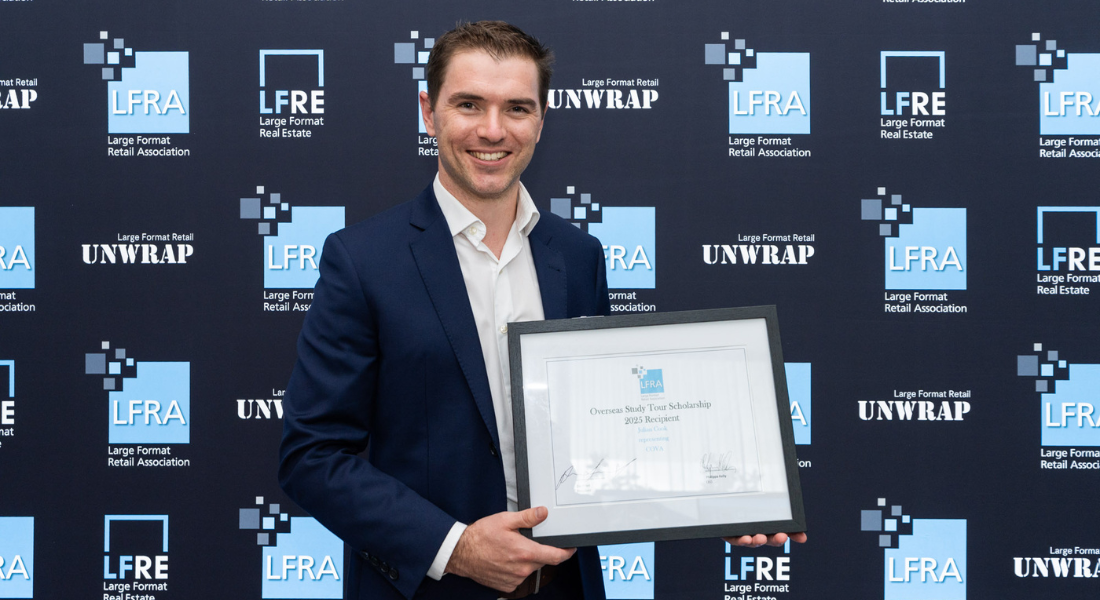
Julian Cook was the recipient of the 2025 Australian Large Format Retail Association Overseas Study Tour Scholarship