
LFRA Gold Coast Forum panel explores sector value, productivity and future growth
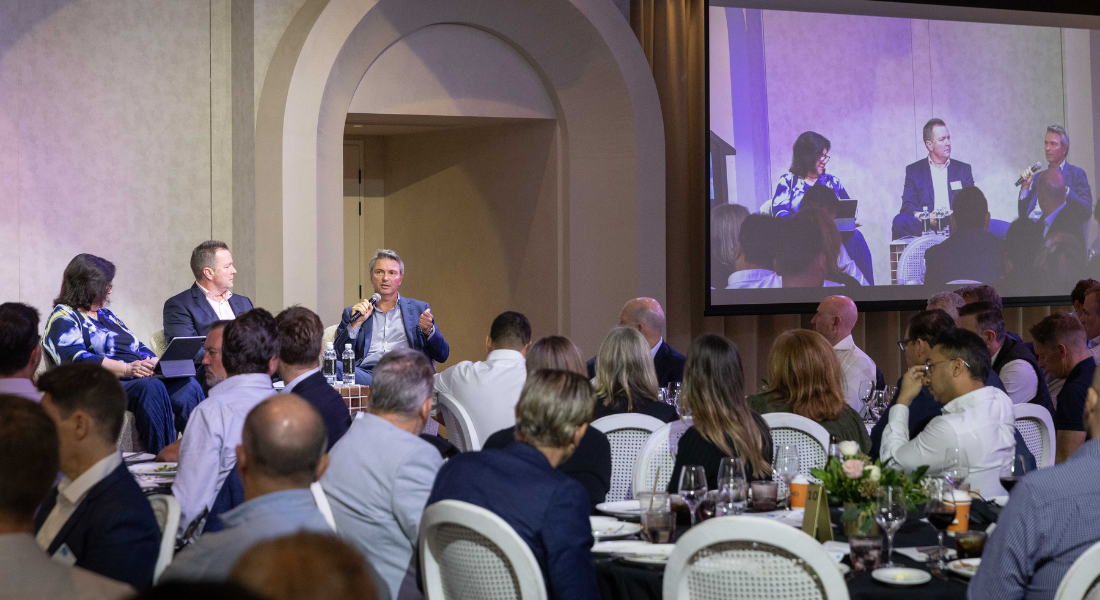
The opening panel discussion at the LFRA Gold Coast 2026 Forum explored Large Format Retail’s value, resilience and future growth.
Moderated by Philippa Kelly, Chief Executive Officer of the LFRA, the session featured James Scott, General Manager, Property, at Harvey Norman and Vice President of the LFRA, and Tom Irving, Senior Director, Valuation & Advisory Services, with CBRE.
The discussion examined the factors shaping the sector’s performance, including economic rent, construction costs, leasing conditions, supply constraints, outgoings, valuation trends and the continued evolution of Large Format Retail centres.
 Economic rent was a key theme because it sits at the centre of the sector’s growth challenge: Large Format Retailers need more space, vacancy is low, and new supply depends on projects being financially viable.
The issue is becoming increasingly relevant as land prices and construction costs continue to place pressure on project feasibility, with some Large Format Retailers already paying above what would traditionally be considered market rent to secure new stores.
CBRE’s Tom Irving provided further context from a valuation perspective, explaining that economic rent reflects the full cost of delivering new space and achieving a return on that investment.
He pointed to construction costs, land costs, approvals, consultants, development management fees and tenant incentives as part of the overall delivery cost for new projects.
On recent feasibility work in Queensland, Mr Irving said Large Format Retail construction costs were at “historic levels” after costs had at least doubled over the past five years.
The role of anchor tenants was also discussed. While some anchor tenants may pay lower rents than smaller tenants, they play an important role in driving traffic, supporting pre-commitment and helping developments get off the ground.
 Mr Irving said Large Format Retail has performed strongly through periods such as the GFC and COVID, with “minimal tenant fallovers” and “really robust tenant trading performance”.
Low vacancy and limited new supply have also created competition between retailers for available sites. From an investment perspective, this depth of demand continues to set Large Format Retail apart from more traditional retail formats.
Outgoings were also raised as a pressure point, particularly the impact of statutory costs such as land tax, rates and insurance.
The discussion highlighted that increases in statutory costs can flow through the sector, affecting owners, retailers and ultimately customers. Mr Irving noted that while these costs are sometimes viewed as a landlord issue, “one way or the other” the impact flows through to tenants and consumers.
This issue remains central to LFRA’s ongoing advocacy work, particularly in relation to the impact of taxes, statutory charges and red tape on planning approvals, productivity, investment confidence and the ability to deliver new retail space in high-demand markets.
Looking ahead, the panel discussed the next generation of Large Format Retail centres and how they are continuing to evolve.
Ms Kelly noted that recent centres increasingly include features such as charging infrastructure, sustainability initiatives and stronger ESG performance.
Mr Scott pointed to examples already being introduced across centres, including rooftop bees, composting and market gardens, with a focus on community engagement and social impact.
Innovation in construction methodology was also raised as an opportunity to reduce costs and support more affordable accommodation for retailers, and this includes AI in design, documentation and approvals, as well as modular construction, robotics and 3D printing.
The future mix of Large Format Retail centres was another key theme. Mr Irving said the strongest centres are often those that combine Large Format Retail with complementary uses, including medical, service stations, food and dining.
“When you can really become that town centre type hub with Large Format Retail as a big part of it, that’s when things really work the best,” Mr Irving said.
While the sector faces challenges around supply, development feasibility, statutory costs and productivity, the discussion reinforced strong confidence in Large Format Retail’s resilience and future growth.
For LFRA member representatives at the Forum, the session provided valuable insight across Large Format Retail, property, development, valuation, leasing, asset management and centre operations, reinforcing the importance of understanding the sector’s value from both a retailer and property perspective.